The Hard Choices of Transit Network Redesign
One of the conversations we’re bringing to the forefront at upcoming Navigate Mobility is this: what do you optimize for when resources are fixed? Transit network redesign forces a question most agencies prefer to avoid: What do you do when you cannot serve everyone equally? More frequency in the core usually means less coverage at […]
Celebrating World Transport Day
Urban passenger transport moves billions of people every day without relying on private cars. Buses, metros, trams, and rail systems form the backbone of city life, enabling access to jobs, education, and services at a massive scale. In the busiest corridors, public transport can carry tens of thousands of passengers per hour which is far […]
Vienna’s 26% Tipping Point: Why Mobility Needs a Rethink
In 1993, 40% of all trips in Vienna were made by car. Fast forward to 2023, and that number has fallen to 26%. Meanwhile, public transport, walking, and cycling now account for a staggering 75% of the modal split. This was not luck. It was the result of a deliberate, multi decade strategy that combined […]
5 Structural Shifts Redefining Urban Mobility in Europe
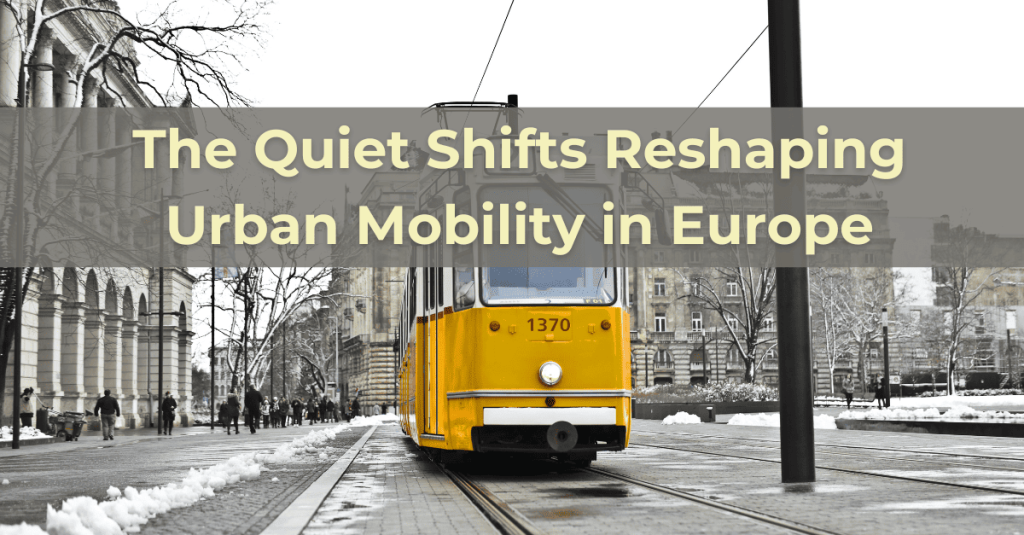
By 2026, Paris’s 15-minute city model delivers 80% of daily needs within walking or cycling distance for 2 million residents, which cuts the car use by 35% without mandates. This is not an isolated success. Across Europe, quieter structural shifts are already changing how cities plan, regulate, and invest in mobility. Below are five that […]
The default infrastructure – walkability, transit and cycling
written by Vishesh Ranglani (Conference Lead / Navigate Mobility) We like to tell ourselves we’re making progress. adding a bike lane here, a crosswalk there but what we’re really doing is sprinkling “human touches” onto a system still built for machines. Walkability gets framed as an amenity instead of a necessity. Here’s the thing: every […]
If Cars are the Default Citizen, People are the Afterthought
written by Vishesh Ranglani (Conference Lead / Navigate Mobility) We don’t actually design cities for people. We design them for cars, and then try to squeeze people back in around the edges. We talk about “walkability,” “mixed use,” and “transit-oriented development” but when it comes time to approve a plan, it’s the parking ratios, traffic […]
What cities actually need to evolve and what senior decision-makers should be prioritizing?
In this new short video series where we hear a candid take from attendees, we bring you a perspective from Jaromir Beranek, Chairman of the International Relations and EU Funds Committee, City of Prague. Here are a few takeaways he believes matter most for cities and decision-makers: ✔ Prague is tasked with rolling out 1,500 […]
Horizon Europe 2028 – 2034

The EU’s next big research and innovation programme is already taking shape and mobility is right at the center. Clean aviation, connected & automated transport, smart cities, rail, deep tech… the opportunities are massive. But so is the competition. We broke down the essentials into a quick visual guide: 👉 where the €175B goes👉 how […]
Managing mobility in towns under 100,000?
Managing mobility in towns under 100,000? You’re likely balancing tight budgets, limited staff, and weak public transport options. Good news: The new SUMP Topic Guide from the EU Urban Mobility Observatory offers practical, tailored solutions to help. Key highlights: Featured practical measures include: Safe school zonesWalking and cycling infrastructureDemand-responsive bus servicesActivation of public spaces The […]
The Clean Air Law. EU Directive 2024/2881
Air pollution in Europe has improved over the decades. Still, about 300,000 people die prematurely each year due to it. In 2021, 97% of urban residents faced fine particulate matter (PM2.5) levels above WHO’s latest guidelines.PM2.5 is the most harmful air pollutant. The EU Directive 2024/2881 represents a comprehensive response that significantly tightens air quality […]